
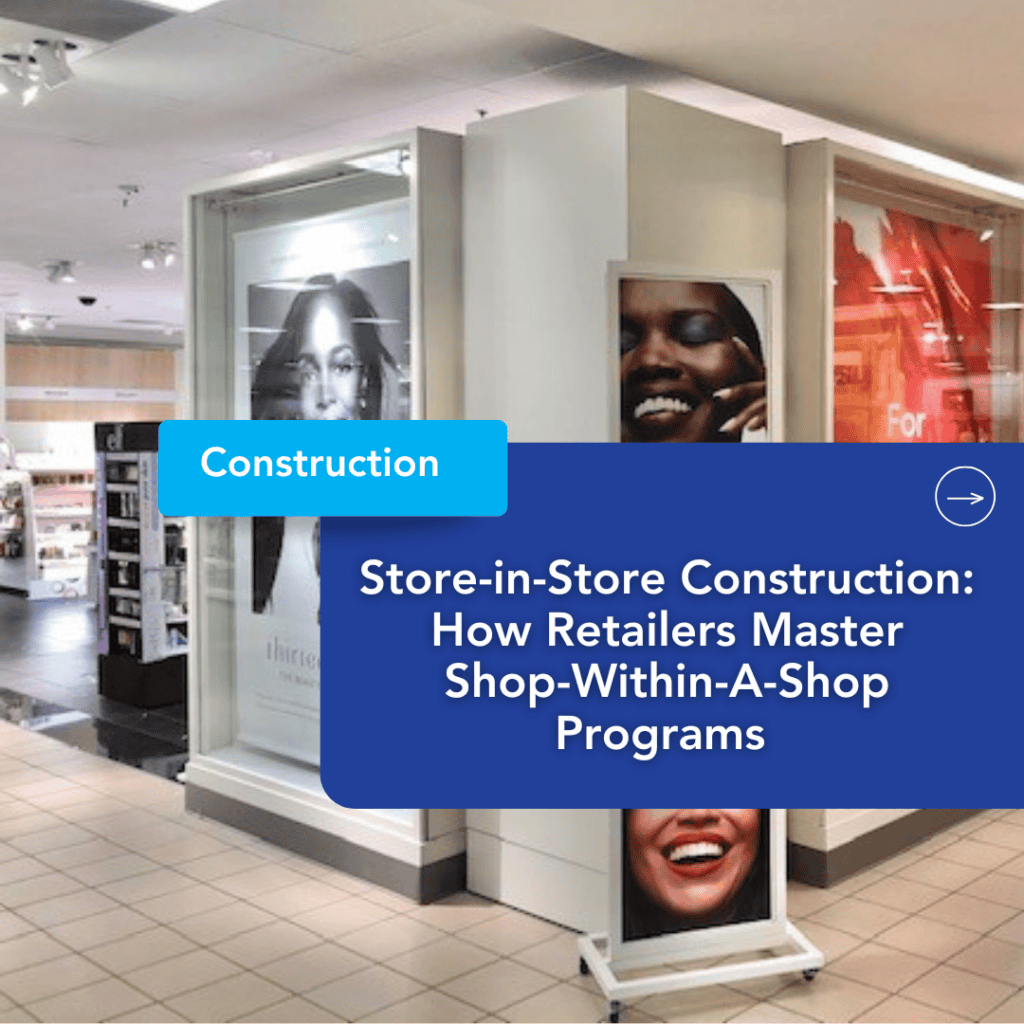
Quick Answer
How do retailers successfully build and manage store-in-store programs across multiple locations?
Successful store-in-store construction requires coordinating two brands’ standards within one physical space—managing separate design identities, distinct MEP requirements, phased construction that keeps the host store operational, and rollout schedules that scale across dozens or hundreds of locations. Programs managed through centralized program management deliver consistent brand experiences at every site while compressing timelines and protecting revenue throughout construction.
Read on for a look at how multi-site store-in-store programs work, what makes them different from standard retail buildouts, and how the right partner turns complex dual-brand construction into a repeatable, scalable process.
A pharmacy chain partners with a healthcare provider to build clinics inside existing stores. A department store converts a licensed beauty brand footprint into its own branded cosmetics experience across nearly 600 locations. A grocery chain integrates a second retail brand into 50 existing stores, complete with new refrigeration lines and separate merchandising standards.
These are store-in-store programs—and they’re reshaping how retailers use their physical footprints. The concept is straightforward: place one branded experience inside another retailer’s space to drive traffic, expand services, and increase revenue per square foot. The construction behind it is anything but simple.
At Sevan Multi-Site Solutions, we’ve managed store-in-store programs for brands across the retail, grocery, healthcare, and fuel & convenience sectors. From JCPenney’s 591-location cosmetics conversion to Luxottica’s multi-brand eyewear rollouts spanning seven distinct brand identities, we’ve learned that store-in-store success depends on specialized construction coordination that most general contractors aren’t built to provide.
This article covers:
- Why store-in-store programs require a different construction approach
- Construction phasing strategies that keep host stores open
- Quality control and brand compliance across multi-location rollouts
- Real program results from national store-in-store rollouts
The Cost of Construction Surprises
A pharmacy chain partners with a healthcare provider to build clinics inside existing stores. A department store converts a licensed beauty brand footprint into its own branded cosmetics experience across nearly 600 locations. A grocery chain integrates a second retail brand into 50 existing stores, complete with new refrigeration lines and separate merchandising standards.
These are store-in-store programs—and they’re reshaping how retailers use their physical footprints. The concept is straightforward: place one branded experience inside another retailer’s space to drive traffic, expand services, and increase revenue per square foot. The construction behind it is anything but simple.
At Sevan Multi-Site Solutions, we’ve managed store-in-store programs for brands across the retail, grocery, healthcare, and fuel & convenience sectors. From JCPenney’s 591-location cosmetics conversion to Luxottica’s multi-brand eyewear rollouts spanning seven distinct brand identities, we’ve learned that store-in-store success depends on specialized construction coordination that most general contractors aren’t built to provide.
This article covers:
- Why store-in-store programs require a different construction approach
- Construction phasing strategies that keep host stores open
- Quality control and brand compliance across multi-location rollouts
- Real program results from national store-in-store rollouts
Why Store-in-Store Construction Is Different
Standard retail construction is complex enough. Store-in-store programs multiply that complexity by introducing a second set of brand standards, stakeholders, and operational requirements—all within a space that’s already built and operating.
Standard Retail Buildout | Store-in-Store Buildout |
One brand’s design standards | Two brands’ standards reconciled in one space |
New or vacant space | Existing building with legacy MEP and structural constraints |
Construction site is closed to public | Host store remains open throughout |
Single stakeholder group | Multiple stakeholder groups across both organizations |
Standard permitting | Permitting may span building, health, and specialty licensing |
Two Brands, One Space
Every store-in-store buildout involves reconciling two design languages within a shared footprint. Partition systems, ceiling treatments, flooring transitions, signage placement, lighting zones, and millwork detailing all require coordination between both brand teams before work begins.
Existing Conditions Can Complicate Everything
Unlike ground-up construction, store-in-store projects start with an existing building—complete with structural constraints and conditions that rarely match available drawings. This is where site surveys become critical. Accurate existing conditions documentation—including reality capture and BIM for complex spaces—prevents the costly surprises that derail timelines and cascade across entire programs.
The Host Store Never Stops
Customers are shopping while the new walls go up. Staff are operating registers while contractors install new electrical circuits overhead. This operational continuity requirement shapes everything—from when work can happen to how materials move through active retail spaces.
Planning a Program That Scales
Getting one shop-within-a-shop right is a project. Getting 50, 200, or 591 right is a program—and programs demand a different planning approach.
Stakeholder Alignment Across Organizations
Store-in-store programs involve more decision-makers than standard retail construction management. The host retailer’s real estate, design, operations, and facilities teams all have requirements. The embedded brand’s leadership has its own standards and expectations. Aligning these stakeholders early on design standards, construction protocols, and approval workflows helps prevent programs from stalling as conflicting priorities surface site by site.
Prototype Development and Standardization
Successful programs develop a scalable prototype—a repeatable design solution that accommodates the most common existing conditions while maintaining both brands’ standards. In our JCPenney cosmetics conversion program, we managed multi-wave rollouts averaging 75 stores per 6-week cycle across 591 locations—a pace only possible because standardized specifications eliminated interpretation variances from one location to the next.
Site Assessment and Prioritization
Comprehensive site surveys in retail construction programs give teams the data needed to sequence locations intelligently. Sites with adequate electrical capacity and favorable layouts move first. Sites requiring significant infrastructure upgrades get scheduled later, with longer lead times built in.
Construction Phasing and Execution
Deminising and Separation
The first physical step is establishing the boundary between host and tenant spaces. Demising walls, temporary barriers, and dust containment systems protect active retail areas from construction impacts. In healthcare-in-retail applications, separation requirements are especially stringent, with clinical-grade barriers and air-handling protocols.
MEP Coordination Within Active System
MEP coordination within active systems involves tapping into an existing building’s mechanical, electrical, and plumbing systems while those systems continue serving the host store, one of the most technically demanding aspects. Electrical panel upgrades, HVAC zone modifications, and plumbing additions must be planned to minimize downtime, and are often executed during overnight windows.
Millwork, Fixtures, and Brand Installation
In our work with Luxottica, we completed 400+ millwork installations across 215 sites for brands including LensCrafters, Sunglass Hut, Ray-Ban, Oakley, Oliver Peoples, Target Optical, and Pearle Vision. Each brand has specific fixture standards. Managing that complexity across hundreds of locations required detailed specifications, pre-qualified installers, and systematic quality verification.
Quality Control at Scale
When two brands share one space, quality control means protecting both brand identities across every location. Construction program management for store-in-store programs requires inspections at defined milestones:
- Post-demolition and rough framing verification
- MEP rough-in confirmation before walls close
- Millwork and fixture placement against brand standards
- Technology systems testing and commissioning
- Final walkthrough with both brand representatives
Progressive verification catches problems when they’re inexpensive to correct. Smart programs also treat initial locations as learning opportunities by using construction data and feedback from the first wave to inform improvements for subsequent waves.
How Store-in-Store Shows Up Across Sectors
Retail Concessions and Brand Conversions
Department stores and large-format retailers regularly convert branded concession spaces, managing lease obligations, brand transitions, and customer experience continuity simultaneously.
Healthcare-in-Retail
Clinics inside pharmacies, urgent care within grocery stores, and primary care embedded in big-box retailers combine retail buildout complexity with healthcare facility regulations and patient privacy requirements.
Co-Branded and Food Service Integration
Some programs merge two full retail brands into a shared space. Others embed food service capabilities—complete with ventilation, health code compliance, and utility infrastructure—into spaces originally designed for packaged goods retail.
Case Study Results
JCPenney Brand Conversion Program. Our JCPenney program managed the conversion of Sephora-branded cosmetics spaces into JCPenney-branded retail across 591 store locations in 29 districts. The program was divided into waves, averaging 75 stores per 6-week cycle, with no more than 6 stores impacted within a single district in any wave.
Luxottica Multi-Brand Retail Rollout Luxottica’s program spanned 215 completed sites, 360 lease reviews, and 400+ millwork installations across seven distinct eyewear brands. Sevan’s program management and real estate development expertise coordinated lease logistics, brand-specific millwork, and installation sequencing—delivering consistent results where no two sites shared identical host conditions.
Conclusion
Store-in-store construction programs represent one of the most complex challenges in multi-site retail—combining brand-standard buildouts with the constraints of building within active, occupied spaces. The difference between a program that scales and one that stalls comes down to specialized coordination, centralized program management with a single-source of accountability, standardized specifications, pre-qualified contractor networks, and technology platforms providing portfolio-wide visibility.
At Sevan, we’ve delivered store-in-store programs for brands like JCPenney and Luxottica—managing hundreds of dual-brand buildouts within active retail environments. Whether you’re embedding a new service concept or managing a multi-hundred-location brand conversion, our team brings the multi-site expertise that protects both brands while accelerating your program timeline.
Explore our retail case studies or contact us to discuss how Sevan’s integrated approach can support your next store-in-store program.
FAQs
How long does a store-in-store buildout typically take per location?
A fixture-and-millwork-focused brand conversion might take from a few days to multiple weeks per site. A healthcare clinic or food service buildout typically requires several weeks to a few months due to MEP modifications and specialized equipment. Multi-site programs accelerate overall timelines by executing locations in parallel.
Can the host store remain fully operational during construction?
In most cases, yes. Strategic phasing, barrier systems, and off-hours construction schedules allow the host retailer to maintain operations throughout. The key is working with a partner experienced in occupied retail environments.
What's the biggest risk in store-in-store construction programs?
Existing conditions that don’t match available documentation. Thorough site surveys using reality capture technology mitigate this risk by providing accurate as-built data before design and construction begin.
How do permitting requirements differ for store-in-store buildouts?
Complexity depends on the embedded concept. A retail fixture swap may require a basic building permit. A healthcare clinic triggers health department, ADA, and licensing reviews. Multi-jurisdictional programs benefit from centralized zoning and permitting coordination.
